Poster Presentation: Cold Nociception in Drosophila
After 4 industrious months of working in a Drosophila genetics lab, I recently had the opportunity to present my research at an event hosted by the Neuroscience Institute at Georgia State University. This was my first time completing a poster presentation and it was an incredible opportunity to share my results with other eager scientists.
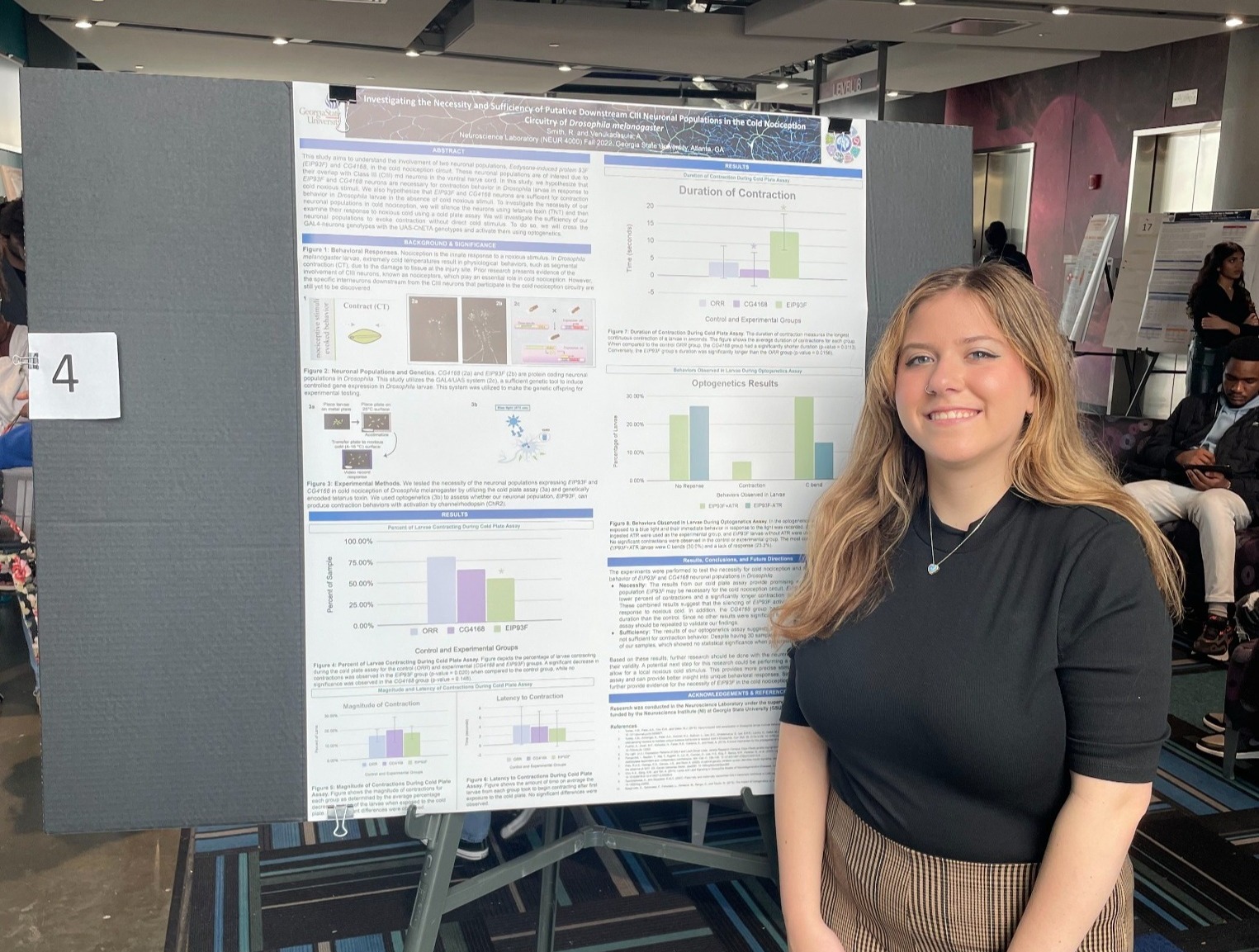
My partner Anukruthi Venukadasula and I investigated the involvement of the neuronal populations CG4168 and EIP93F in the cold nociception circuit of Drosophila melanogaster larvae.
We hypothesized that EIP93F and CG4168 neurons were necessary for contraction behavior in Drosophila larvae in response to cold noxious stimuli. In addition, we hypothesized that EIP93F and CG4168 neurons were sufficient for contraction behavior in Drosophila larvae in the absence of cold noxious stimuli.
In order too investigate our hypotheses, we completed genetic crosses utilizing the GAL4/UAS system to produce populations expressing our desired genes.
To examine the necessity of our neuronal populations in cold nociception, we silenced our GAL4-neurons genotypes using UAS-tetanus toxin (TNT) and then examined their response to noxious cold using a cold plate assay. To investigate the sufficiency of our neuronal populations in evoking contraction behavior, we crossed the GAL4-neurons genotypes with the UAS-ChETA genotypes which allowed us to activate them using optogenetics.
Through our experiments, we discovered statistically significant results for the neuronal population EIP93F. We saw significantly less EIP93F larvae contract as a percentage of our total sample when compared with our wildtype control.
We also observed that the CG4168 group had a significantly shorter duration of contractions when compared to the control. Conversely, the EIP93F group’s contraction duration was significantly longer than the control group.
We concluded that the results from our cold plate assay provide promising evidence that the neuronal population EIP93F may be necessary for the cold nociception circuit. Unfortunately, no significant results were observed for the EIP93F group when an optogenetics assay was completed, suggesting that this population is not sufficient for contraction behavior.
You can review our full poster below to get a more in-depth look into our experiments.
You can also read through our research proposal to learn more about the methods used and understand the significance of this research.
Thank you for reading!
Post a comment